



In polymer chemistry, a feedstock is the foundational raw material that undergoes chemical transformation to produce polymers. Feedstock selection is a critical decision in sustainable material development, fundamentally dictating the molecular structure, environmental impact, and practical applications of the resulting product. A sustainable material is defined heavily by the origin of its carbon building blocks.
As the materials science sector embraces green chemistry, focus is increasingly directed at the molecular genesis of polymers. Choosing the right feedstock influences carbon accounting, energy consumption, and the physical properties of bio-based materials, shaping the lifecycle from origin to commercial deployment.
Why Material Industries Are Exploring Alternatives to Fossil-Based Feedstocks
Traditional polymers rely predominantly on petrochemical feedstocks, derived from crude oil and natural gas. These feedstocks are extracted from deep underground. Where carbon has been stored over geological timescales. Through polymerization—a chemical process in which small molecules known as monomers are linked into repeating molecular structures—these carbon sources are converted into functional polymers used across a wide range of industrial applications.
This linear model is being replaced due to two specific scientific challenges. First, extracting fossil carbon releases ancient, sequestered carbon into the atmosphere, disrupting the global carbon cycle and accelerating greenhouse gas accumulation. Second, fossil-derived polymers consist of highly stable carbon-carbon bonds that resist environmental degradation. Because these molecular bonds do not break down naturally, the materials accumulate persistently in the environment. Shifting to renewable alternatives mitigates both atmospheric carbon addition and environmental persistence by relying on contemporary carbon sources.
Different Types of Feedstocks for Sustainable Materials
The transition to bio-based materials relies on securing alternative carbon sources, each presenting unique chemical compositions and processing requirements.
Plant-Based Feedstocks: Renewable but Resource-Dependent
First-generation bio-based feedstocks are commonly derived from agricultural crops containing carbohydrates such as starch and sucrose. These carbohydrates serve as sources of glucose, a simple sugar that functions as a highly reactive precursor for chemical catalysis. Plant-based feedstocks are categorized as renewable because the crops can be replanted and harvested in short agricultural cycles.
However, relying on first-generation feedstocks introduces significant resource dependency. Cultivating these crops requires substantial land use, irrigation, and synthetic fertilizers. This dynamic diverts agricultural resources from food production to chemical synthesis. Consequently, while carbohydrate feedstocks facilitate the production of sustainable materials, their reliance on agricultural inputs necessitates exploring less resource-intensive alternatives to support large-scale industrial manufacturing.
Agricultural Residues: Valorizing Agricultural Waste Streams
Agricultural residues, including wheat straw, corncobs, sugarcane bagasse, and other crop byproducts, represent second-generation feedstocks. These materials consist of lignocellulosic biomass, which is the dry, structural plant matter left over after food harvesting. Crucially, plant-based ≠ automatically sustainable. If harvesting a bio-based feedstock drives deforestation, depletes water tables, or directly competes with global food security, its net ecological footprint remains negative.
Valorizing (adding economic and practical value to) agricultural waste streams resolves this conflict. Lignocellulosic biomass comprises three complex polymers: cellulose, hemicellulose, and lignin. By employing advanced hydrolysis techniques (chemical breakdown processes utilizing water and precise catalysts or enzymes), materials scientists isolate these components without requiring additional arable land. Using agricultural residues for bio-based materials successfully uncouples polymer production from food systems.
Textile Waste: Unlocking the Potential of Recycled Materials
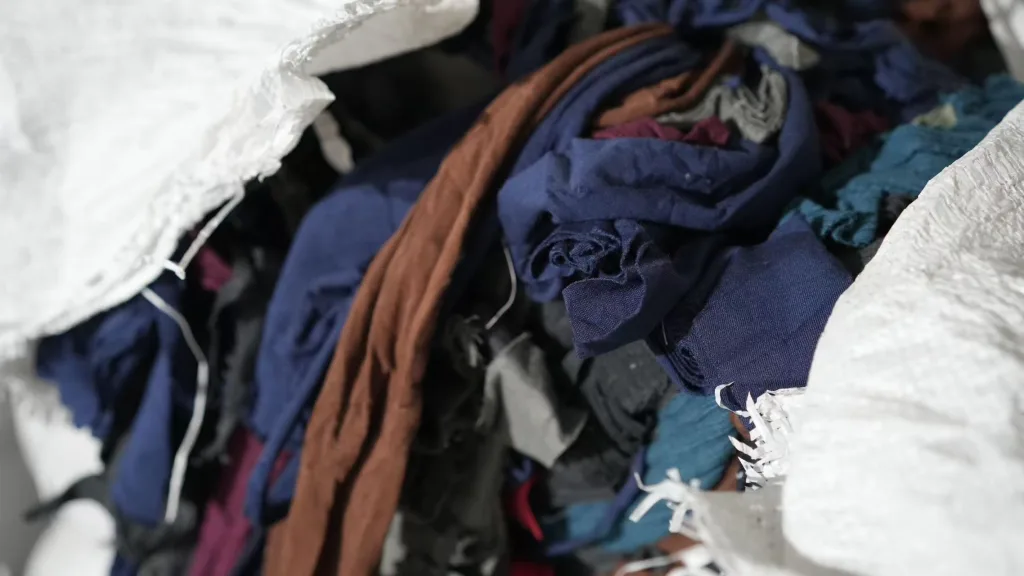
Textile waste, particularly cotton-rich fabric, serves as a high-yield feedstock for chemical recycling. Cotton is composed almost entirely of natural cellulose. When discarded textiles undergo chemical depolymerization—a controlled process that breaks long polymer chains back down into their distinct, original monomers—the recovered molecules can be purified and re-polymerized into new materials.
Unlocking this potential establishes a closed-loop system. Instead of relying on virgin biomass extraction, the chemical industry can source its fundamental carbon building blocks directly from municipal waste. This approach mitigates landfill accumulation while providing a concentrated, consistent cellulose source for synthesizing advanced sustainable materials.
How Feedstock Choice Influences Sustainable Material Performance
The molecular composition of the starting material dictates the entire manufacturing process, directly influencing both environmental metrics and the physical capabilities of the final polymer.
Impact on Carbon Footprint
Feedstock choice fundamentally alters a product’s carbon footprint, which encompasses the total greenhouse gases generated throughout its lifecycle. Bio-based feedstocks operate within the biogenic carbon cycle. Biogenic carbon refers to the carbon dioxide that plants absorb from the atmosphere during photosynthesis as they grow.
When these agricultural residues or crops are converted into bio-based materials, the carbon incorporated into the polymer matrix originates from the current atmospheric balance rather than ancient fossil reserves. Consequently, the net addition of new carbon to the atmosphere is significantly reduced. This inherent sequestration mechanism is critical for minimizing the global warming potential associated with industrial manufacturing.
Impact on Material Properties
The chemical architecture of a feedstock determines the specific monomers that can be synthesized, which in turn defines the macroscopic properties of the final polymer. Different organic precursors yield distinct molecular geometries.
For instance, FDCA contains a rigid furan ring structure that can influence polymer chain mobility and molecular packing. When these monomers undergo polymerization, their structural rigidity severely restricts the movement of the resulting polymer chains. This restriction increases the glass transition temperature, which is the specific temperature range where a polymer shifts from a hard, glassy material to a soft, rubbery state. A higher glass transition temperature provides greater thermal stability and mechanical strength, allowing bio-based materials to meet rigorous industrial specifications.
Impact on Circularity and End-of-Life Options
Feedstock origin directly informs the end-of-life pathways available for a sustainable material. Polymers synthesized from specific bio-based aliphatic (open-chain) feedstocks contain ester bonds that are highly susceptible to enzymatic hydrolysis. In this process, specific microorganisms and moisture break the polymer bonds, converting the plastic into harmless natural compounds under industrial composting conditions.
Alternatively, feedstocks can be selected to produce highly robust monomers intended strictly for chemical recycling rather than biodegradation. By carefully matching the feedstock to the intended application, materials scientists ensure the final polymer aligns precisely with the desired circularity model.
How Agricultural Residues Enable Next-Generation Bio-Based Materials
Transitioning from complex lignocellulosic agricultural waste to high-performance platform chemicals requires highly specialized conversion pathways to isolate useful molecules without degrading them.
From Agricultural Residues to High-Purity FDCA: Leaf Bio’s Material Innovation Pathway
Leaf Bio utilizes agricultural residues, including corncobs and crop straw, as renewable carbon sources for producing advanced bio-based chemical building blocks.
Lignocellulosic biomass contains complex structures composed of cellulose, hemicellulose, lignin, and other compounds, creating challenges in selective conversion and purification. Through advanced biomass conversion technologies, Leaf Bio enables the transformation of these renewable resources into high-purity intermediates for further material development. These intermediates can be converted through chemical transformation pathways into FDCA (2,5-furandicarboxylic acid), a key bio-based platform molecule for next-generation materials. High-purity FDCA is essential for producing polymers with consistent quality, as trace impurities can influence polymerization efficiency, color stability, and final material performance. By utilizing agricultural residues as renewable carbon sources, Leaf Bio develops material pathways that expand resource utilization while reducing reliance on food-competing feedstocks.
Feedstock Choice in Sustainable Packaging Materials
The packaging industry requires materials that combine functional performance, product protection, and resource efficiency. Selecting the right feedstock plays an important role in developing packaging materials with the required molecular structure, performance characteristics, and lifecycle potential.
Moving Beyond Traditional Fossil-Based Packaging
Flexible and rigid packaging applications require high barrier properties. A barrier property is a material’s ability to block the transmission of specific gases, such as oxygen, carbon dioxide, and water vapor. Effective gas barrier performance helps extend product shelf life, prevent oxidation, and maintain the quality of sensitive products.
Moving beyond conventional plastics requires identifying renewable feedstocks capable of yielding monomers with equal or greater structural density. Sustainable packaging materials must completely fulfill these functional requirements; otherwise, the resulting food waste would immediately negate the environmental benefits of utilizing green chemistry.
PEF Resin: A Bio-Based Alternative Enabled by Renewable Feedstocks
PEF (polyethylene furanoate) is a high-performance bio-based material. It is synthesized by polymerizing bio-derived FDCA with ethylene glycol. The resulting PEF resin exhibits remarkable gas barrier properties largely attributed to its unique molecular structure.
The core of the PEF molecule features a furan ring, which is a five-membered aromatic ring containing an oxygen atom. This structural oxygen atom is highly electronegative, creating a strong dipole moment—a localized imbalance of electrical charge within the molecule. This polarity induces strong attractive forces between adjacent polymer chains. As the chains pull tightly together, they reduce the free volume (the microscopic empty spaces existing between molecules) and restrict overall molecular mobility. This densely packed architecture creates a highly tortuous path for gas molecules attempting to pass through the resin. Consequently, PEF resin provides a robust barrier against oxygen, carbon dioxide, and moisture, establishing it as a highly functional, entirely bio-based solution for the packaging industry.
The Future of Renewable Materials
The ongoing evolution of sustainable material development relies on the continual refinement of feedstock selection, the utilization of agricultural residues and textile waste provides new opportunities to build more resilient and diversified material supply chains. The molecular starting point governs every subsequent phase, from the efficiency of the catalytic conversion and the net carbon footprint of production to the precise thermomechanical properties of the final polymer.
By prioritizing non-food biomass and advancing proprietary purification techniques, the Molecular innovation continues to expand the capabilities of bio-based materials. Ultimately, the careful alignment of renewable feedstocks with advanced green chemistry enables the creation of high-performance sustainable packaging materials that actively support a more circular economy.