


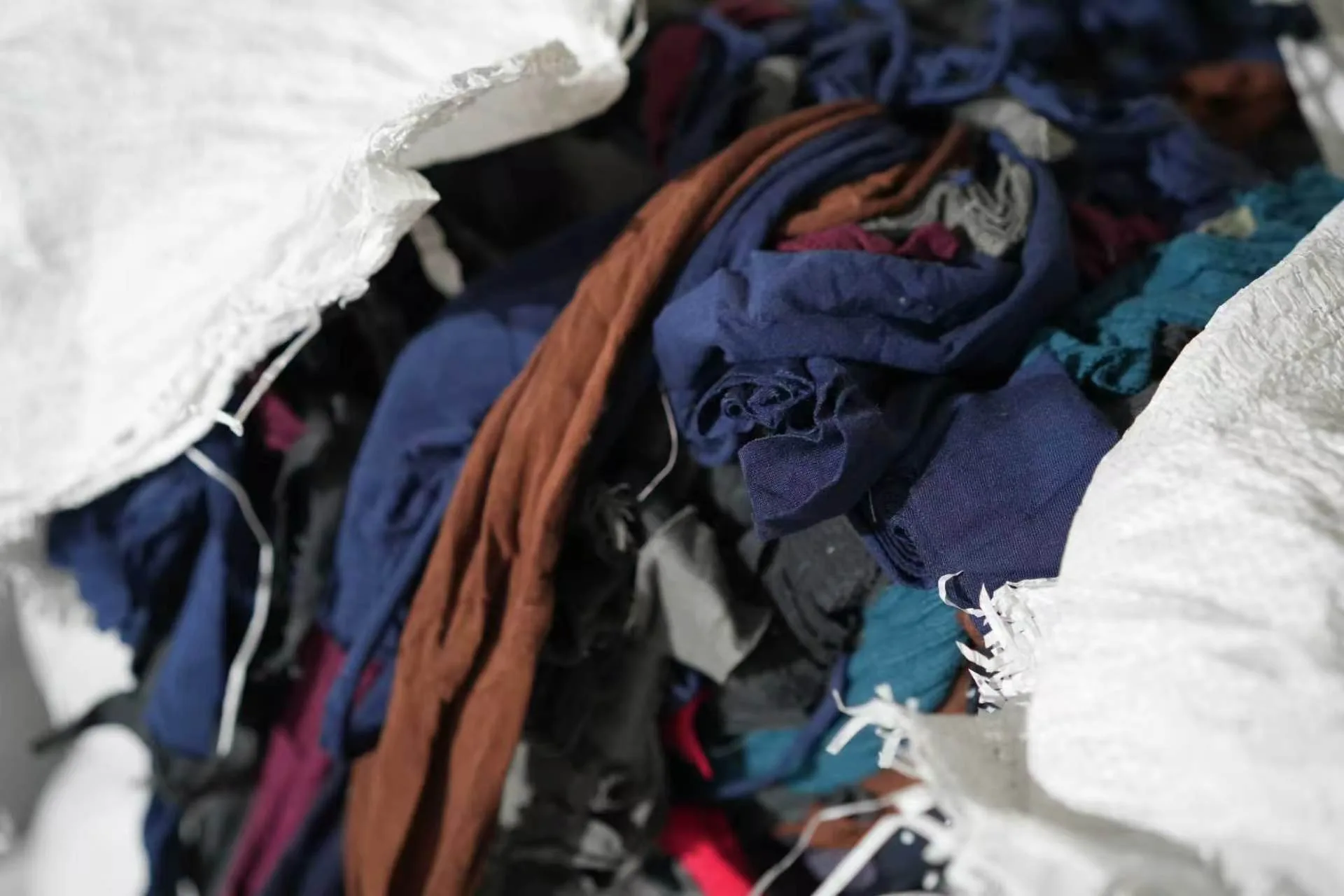
Textile circularity begins with a longer view of material value: how textiles are designed, how long they remain in use, and what their constituent materials can become after use.
Textile-to-textile recycling connects discarded textiles with new textile production. Its potential extends across several approaches, from recovering usable fibers to transforming textile-derived feedstocks into new molecular building blocks. According to Textile Exchange’s Materials Market Report 2026, global fiber production reached an estimated 139 million tonnes in 2025, while textile-to-textile recycled fibers accounted for 0.76% of fiber production. This measures their share of fiber output, rather than the proportion of textile waste collected or recycled.[1]
For Leaf Bio, this gap highlights an opportunity for materials science: developing pathways that connect recovered textile resources with the chemistry and performance requirements of new materials.
What Is Textile-to-Textile Recycling?
Textile-to-textile recycling converts textile waste into fibers or materials used to make new textiles. Depending on the process, it can retain existing fibers, recover polymers, or convert textile-derived resources into chemical building blocks for subsequent material production.
The feedstock can include manufacturing waste and textiles discarded after use. Its origin matters: production offcuts with a known composition can differ considerably from used garments containing multiple fibers, dyes, finishes and accessories.
The distinction from bottle-to-fiber recycling is the source material. Bottle-to-fiber production uses recovered packaging as a textile feedstock; textile-to-textile production returns resources from textiles to textile applications.
Textile circularity is broader. It includes durable design, repair, reuse and collection, as well as recycling. The European Environment Agency identifies longer use, reuse, repair and more effective recycling as complementary measures for improving textile circularity.
A textile-to-textile pathway also needs an identified textile output. Converting textile waste into a chemical intermediate establishes a material recovery step; connecting that intermediate with new fibers and fabrics establishes its role in a T2T pathway.
Beyond Fiber Recovery: Textile Waste as a Material Feedstock
A discarded textile contains resources at several levels: its fibers, the polymers that form those fibers, and the chemical constituents from which new materials can be built. Recycling approaches differ in which of these levels they work with.
Recovering Fibers for New Textile Production
Mechanical processes can open and separate textiles into fibers for further use. For suitable feedstocks, those fibers can be incorporated into new yarns or other textile products.
Fiber length and quality influence the next application. Mechanical processing can shorten fibers, and blending with additional fibers may help meet yarn requirements. The achievable recycled content depends on the feedstock, processing method and desired product.
Recovering Polymers and Chemical Building Blocks
Other approaches work at the polymer or molecular level. Depending on the material, these can involve dissolution and regeneration, or depolymerization followed by purification and repolymerization.
Research demonstrates why these distinctions matter. In a 2024 Science Advances study, Andini and colleagues combined chemical treatment and solvent separation to process mixed textile waste. Their work illustrates how different components can require different recovery steps within one treatment system.[2]
These approaches have distinct feedstock requirements and outputs. Their relevance depends on the composition of the waste and the material intended for production.
Using Recovered Cellulose to Develop New Materials
Cotton, viscose and lyocell contain cellulose. Beyond its use in fibers, cellulose can provide sugars for further chemical conversion. This creates a pathway in which recovered textile resources become feedstocks for a different material chemistry.
For Leaf Bio, recovered cellulose provides a connection between textile waste and FDCA-based material development.
Leaf Bio’s Approach: Converting Recovered Cellulose into FDCA-Based Materials
Leaf Bio’s approach connects cellulosic textile resources with furan-based chemistry and PEF material development.
Our published technology information describes the use of glucose derived from cellulose hydrolysis for FDCA production. Our textile feedstock disclosures include recovered cotton, lyocell, viscose and their blends with synthetic fibers.
The resource highlighted in this pathway is the cellulosic fraction. This does not imply that every component of a blended textile becomes PEF.
From Recovered Cellulose to FDCA
Cellulose hydrolysis produces sugars that can serve as chemical feedstocks. Leaf Bio’s glucose-based route connects this resource with the production of FDCA, or 2,5-furandicarboxylic acid, a platform molecule used in PEF production.
This changes the level at which textile resources are recovered: the value lies in using their chemical constituents to build a new material.
From FDCA to Textile Applications
FDCA is a building block for PEF, poly(ethylene furanoate). PEF production also requires a glycol component; the textile-derived FDCA pathway alone does not establish that every constituent of the resulting material comes from textile waste.
Through BioFleax®, Leaf Bio connects PEF material development with textile applications. The application goal is to bring recovered resources into materials that meet practical requirements for processing and use.
This pathway is best understood as a transition from cellulosic textile feedstock into a new material system. Claims about the recycled content, feedstock mix or performance of a specific product should refer to that product’s supporting documentation.
What Makes a Textile Circularity Pathway Credible?
A credible pathway connects a defined feedstock with measurable recovery, useful outputs and evidence appropriate to each claim.
Traceable Feedstocks and Recycled Content
For a brand or manufacturer, useful questions include where the waste originates, whether it is pre-consumer or post-consumer, and how recycled content is tracked through production.
Leaf Bio has announced GRS certification covering FDCA, PEF and BioFleax® fiber.The Global Recycled Standard addresses recycled material verification and chain of custody, with additional requirements relating to processing, chemicals, social conditions and environmental management.
Certification should be interpreted within its documented scope. It does not, by itself, quantify a product’s carbon footprint or demonstrate the recycling performance of a finished garment.
Material Quality and Application Fit
Recovered resources need to become materials that can be processed and used reliably. Evaluation should therefore consider purity, consistency and the performance requirements of the intended textile application.
For material development, the destination matters alongside the recovery process. A clear application provides a basis for deciding which material properties need to be achieved.
Environmental Evidence with Clear Boundaries
Environmental performance requires assessment of the actual process and its alternatives. Relevant factors include recovery yields, energy and chemical inputs, treatment of residual streams, transport and the material that the recovered output can displace.
A 2024 review of 45 LCA publications on textile reuse, recycling and circular practices highlights the importance of assessment choices and the need for more industrial-scale data. Comparisons should make their functional unit, system boundary and assumptions clear.
Likewise, producing a recyclable material and operating a collection-and-recycling system are separate achievements. Evidence of repeated recycling requires demonstration across the relevant cycles.
Building the Conditions for Textile-to-Textile Circularity
Material innovation needs connections across the textile value chain.
Collection and sorting determine which feedstocks reach which processes. Product design influences material identification, disassembly and compatibility with recovery. Manufacturers translate recovered materials into yarns and fabrics, while brands help establish application requirements and demand.
The scale of the collection task remains significant. The European Environment Agency reports that EU Member States generated approximately 6.94 million tonnes of textile waste in 2022. This regional figure also illustrates why recycling capacity needs to develop alongside effective waste management.
For Leaf Bio, advancing textile circularity means connecting recovered resources with molecular innovation, material engineering and application development. Our work with FDCA-based materials explores how cellulosic textile resources can contribute to new textile material systems.
Textile-to-textile circularity develops through these connections: a traceable source, a suitable conversion process and a material with a clear role in its next application.
References
- Textile Exchange. Materials Market Report 2026. https://textileexchange.org/knowledge-center/reports/materials-market-report-2026/
- Andini, E., et al. Chemical recycling of mixed textile waste. Science Advances, 10(27), eado6827, 2024. https://doi.org/10.1126/sciadv.ado6827