



PEF(ethylene furanoate), is made from FDCA (2,5-furandicarboxylic acid) and ethylene glycol. Both building blocks can be sourced from renewable resources, enabling a fully plant-based material.
PEF applications span packaging, textile fibers and emerging uses in 3D printing and garment components. This versatility reflects a combination of molecular characteristics and processing possibilities: the same material chemistry can be developed into a protective bottle, a textile yarn or a shaped component.
At Leaf Bio, our work in furan chemistry and material engineering develops this foundation through ECOPEF® for packaging and BioFleax® for textiles. Understanding where PEF can be used starts with the relationship between its structure, its processing and the needs of each application.
What Makes PEF Suitable for Different Applications?
The furan ring within PEF’s molecular structure influences chain mobility and interactions between molecules. These features help explain its distinctive gas transport, thermal and mechanical behavior.
PEF’s low oxygen and carbon dioxide permeability makes it well suited to packaging applications where gas-barrier performance matters. Translating these properties into effective product protection involves developing the material, wall thickness and packaging structure around the intended use.
In fiber production, orientation and crystallization become particularly important. Spinning, drawing and heat treatment influence how polymer chains are arranged, shaping the strength and dimensional behavior of the resulting fibers.
PEF therefore offers a material foundation that can be developed around different priorities: content protection in packaging, processing and performance in textiles, or shape and fabrication in designed components.
PEF in Packaging: Protecting Product Quality
Beverage and Food Packaging
Packaging performance is closely connected with the product inside. Oxygen exposure can contribute to oxidation in sensitive foods and beverages, while carbon dioxide loss affects the experience of carbonated drinks.
PEF’s gas-barrier properties make bottles and other protective packaging important application areas. Its stiffness also creates opportunities to investigate material-efficient structures, where wall thickness and geometry are developed together with barrier and handling requirements.
For applications involving hot filling or pasteurization, material grade and crystallinity are important development considerations. Matching thermal behavior with the filling process helps shape packaging that meets both production and product-protection requirements.
Films and Barrier Layers
PEF can also be processed into films and explored as a barrier layer within packaging structures. Here, material selection focuses on protection at relatively low thickness, alongside flexibility and converting requirements.
By providing barrier performance within the material itself, PEF offers a route to exploring simpler packaging structures. Development focuses on how this protection can be combined with the other functions required by the complete package.
ECOPEF® brings these priorities together in Leaf Bio’s plant-based material system for high-performance packaging, connecting content protection with material and processing development.
Beauty, Fragrance and Sensitive Formulations
Product protection is also relevant to beauty and fragrance packaging, where preserving formulation quality and sensory character is a central design consideration.
These needs create a clear direction for PEF-based packaging development: combining gas-barrier performance with packaging design centered on the formulation. Aroma retention, material compatibility and storage stability guide the selection of materials and structures for each product.
PEF in Textiles: Engineering Fibers for Different Uses
Turning PEF into Fibers and Yarns
PEF fiber development brings together polymer quality, spinning conditions and subsequent processing. These steps determine how a material’s molecular characteristics translate into textile performance.
PEF can be melt-spun into fibers, with molecular weight and spinning speed influencing orientation, crystallinity and mechanical performance. Drawing and heat treatment provide further ways to develop fiber properties around the needs of subsequent textile processing.
Through BioFleax®, Leaf Bio develops this material foundation into textile solutions, working across fiber engineering, yarn development and fabric applications.
Performance Wear, Everyday Clothing and Fashion
Different textile applications call for different combinations of properties.
For active and outdoor clothing, development can focus on moisture management, yarn strength and fabric construction. Everyday clothing places emphasis on handfeel, comfort and durability. Fashion applications add another dimension through blends, textile structures and surface effects.
BioFleax®’s development priorities include moisture management, softness, UV resistance and style versatility. The finished textile’s behavior reflects the combination of fiber properties, yarn construction, fabric structure and finishing.
This creates room for distinct material expressions across performance wear, everyday garments and fashion, while retaining a common plant-based material foundation.
PEF in 3D Printing and Garment Components
3D-Printed Buttons and Decorative Details
PEF can also be shaped through fused deposition modeling (FDM), a 3D-printing process that builds objects layer by layer. This extends its application range into customized forms and smaller components, where geometry is an important part of the design.
For Leaf Bio, this processing direction has taken shape in exploratory 3D-printed buttons and decorative accessories. These examples bring plant-based material development into garment details, where shape, texture and customization are part of the design brief.
Zippers and a Consistent Material Approach
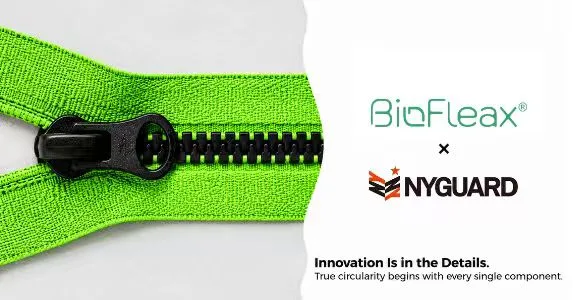
Functional components provide a further development direction. Leaf Bio’s work with NYGUARD explores a zipper made with BioFleax® PEF across the teeth, tape and slider.
The entire zipper is made from PEF, reducing materials diversity within the assembly. This mono-material approach brings circular design considerations into component development, providing a starting point for developing suitable recovery routes. Together, these examples show how PEF applications can extend across fabric and the components that complete a garment.
Developing PEF for Real-World Applications
A bottle, a textile yarn and a printed button place different demands on the same underlying material chemistry. Each requires a suitable balance of molecular weight, thermal behavior, flow, orientation and product geometry.
Leaf Bio’s approach brings furan chemistry, material engineering and application development into the same process. ECOPEF® focuses on packaging needs, while BioFleax® develops plant-based performance materials for textiles. PEF provides a shared material foundation within this broader work.
The expanding range of PEF applications reflects what happens when molecular understanding is developed through processing and product design. For Leaf Bio, that work is guided by a practical ambition: bringing plant-based materials into products with a clear purpose and performance requirement.