


As packaging expectations evolve, protecting product quality has become a critical part of packaging design. Food, beverages, coffee, tea, and other sensitive products can gradually lose flavor, aroma, freshness, or carbonation as gases move through the package over time.
This makes barrier performance essential. Packaging must help control the movement of oxygen, carbon dioxide, moisture, and other factors that can affect product quality during storage and distribution.
PEF resin offers a material-level approach to this challenge. Derived from furan-based building blocks that can come from renewable plant resources, PEF combines a rigid molecular structure with strong intrinsic gas barrier properties, making it well suited to plant-based, high barrier packaging, and other product-protection applications.
The Barrier Challenge in Modern Food and Beverage Packaging
Modern packaging serves as a dynamic, protective interface between sensitive formulations and external environmental conditions.
Different applications demand precise barrier profiles:
- Carbonated Beverages: Require strict retention of dissolved CO₂ to maintain mouthfeel and freshness.
- Coffee, Tea, & Botanicals: Require aggressive protection against O₂ ingress to prevent lipid oxidation while locking in delicate volatile aromatic compounds.
- Fresh & Functional Foods: Depend on controlled gas transmission rates to mitigate flavor degradation during prolonged storage.
As global distribution networks expand and products remain on retail shelves longer, maintaining a low Gas Transmission Rate (GTR) becomes critical to brand reputation and product stability.
Why Flavor and Freshness Are Difficult to Preserve
Flavor and freshness are difficult to preserve because food and beverages are not completely isolated from their surrounding environment after packaging. Over time, gases and other small molecules can move across the packaging material, while chemical reactions inside the product can gradually change its original characteristics.
Furthermore, aroma loss often occurs through sorptive loss or permeation of trace volatile organic compounds (VOCs). When these light molecular weight flavor constituents migrate into or through the packaging matrix, the product loses its characteristic profile long before its formal expiration date.
How Oxygen and Carbon Dioxide Affect Product Quality
Oxygen is one of the most important factors. When oxygen crosses the packaging barrier, it initiates free-radical oxidation reactions with sensitive lipids, vitamins, and delicate flavor compounds. These reactions may alter flavor, aroma, color, and other quality attributes, gradually reducing the product’s original sensory profile.
Carbon dioxide creates a different challenge for carbonated beverages. Instead of entering the package, CO₂ can gradually escape through the packaging material. As carbonation decreases, the beverage may lose part of the freshness and sensory experience expected by consumers.
The Growing Need for High-Barrier Packaging
As products are stored, transported, and displayed for longer periods, food and beverage packaging must do more than contain the product. It needs to act as a protective barrier that limits unwanted molecular exchange with the surrounding environment.
This is driving greater demand for high-barrier packaging that helps maintain flavor, aroma, freshness, and carbonation for longer. Strong barrier performance can also give manufacturers greater flexibility when designing bottles, containers, and films for different preservation requirements.
For food and beverage packaging, this is especially important when longer shelf life and extended distribution are required. For premium packaging, where flavor, aroma, and freshness contribute directly to perceived product value, maintaining these qualities is essential to protecting the overall consumer experience.
Why Conventional Barrier Solutions Are Not Always Enough
When a packaging material does not provide sufficient gas barrier performance on its own, manufacturers can introduce additional functional layers or coatings to improve protection. These conventional barrier solutions may include multi-layer structures, co-extruded layers, functional coatings, or other barrier materials designed to limit the transmission of oxygen, carbon dioxide, moisture, or other molecules.
While effective at lowering permeability, these multi-material approaches introduce structural complexity. They complicate conversion processes, increase manufacturing scrap rates, and often present severe challenges for mono-material sorting and mechanical recycling streams.
Consequently, the industry is increasingly seeking intrinsic barrier solutions—materials where high gas protection is an inherent property of the primary polymer backbone, eliminating the need for complex, multi-layer architectures.
Balancing Barrier Performance and Packaging Design
A conventional high-barrier structure often achieves its performance by combining materials with different functions. This approach allows manufacturers to tailor packaging for specific applications, but it also means that barrier performance is not necessarily provided by the primary packaging material itself.
For bottles and containers, adding an additional barrier layer can increase the complexity of the package structure. For films, coatings or multiple functional layers may be incorporated to achieve the required level of gas protection.
As a result, packaging designers need to balance barrier performance with other requirements such as mechanical strength, thermal stability, transparency, processability, and package weight. The more functions that need to be achieved through separate layers, the more carefully the overall structure must be engineered.
The Complexity of Multi-Layer Barrier Structures
Multi-layer packaging combines different material properties within a single package. Barrier materials such as EVOH and inorganic coatings can be incorporated into layered structures to improve resistance to gas transmission.
However, each additional layer adds material interfaces and structural complexity, which can make processing, sorting, and recycling more challenging. In particular, multi-material structures often complicate mechanical recycling streams due to phase incompatibility during re-melting.
This is driving interest in materials that can deliver strong barrier performance intrinsically, without relying entirely on additional functional layers.
The Need for High Performance with More Sustainable Material Options
Sustainability in packaging cannot be evaluated only by asking where the raw material comes from. Material performance, manufacturing efficiency, resource use, and end-of-life options all matter.
A renewable material that cannot meet the functional requirements of a package may not provide a practical solution. Conversely, a high-performance material with renewable origins can create a stronger foundation for developing sustainable packaging materials that are designed around real product-protection needs.
Introducing PEF Resin as a New Approach to the Barrier Challenge
PEF provides a material-science approach to the barrier challenge by integrating renewable material origins with strong intrinsic gas-barrier properties.
What Is PEF Resin?
PEF, or poly(ethylene 2,5-furandicarboxylate), is a furan-based material synthesized from FDCA (2,5-furandicarboxylic acid) and ethylene glycol. When both building blocks are sourced from renewable biomass, PEF can provide a fully bio-based material pathway.
Its defining structural feature is the furan ring derived from FDCA. This rigid ring is incorporated directly into the polymer backbone and plays an important role in determining how the molecular chains move and pack together.
Rather than treating barrier protection as an external feature, PEF resin develops its gas-barrier performance from its molecular architecture. This makes it particularly relevant for packaging applications where oxygen and carbon dioxide transmission must be carefully controlled.
From Renewable Plant-Based Resources to PEF
The renewable origin of PEF resin begins with the production of its molecular building blocks.
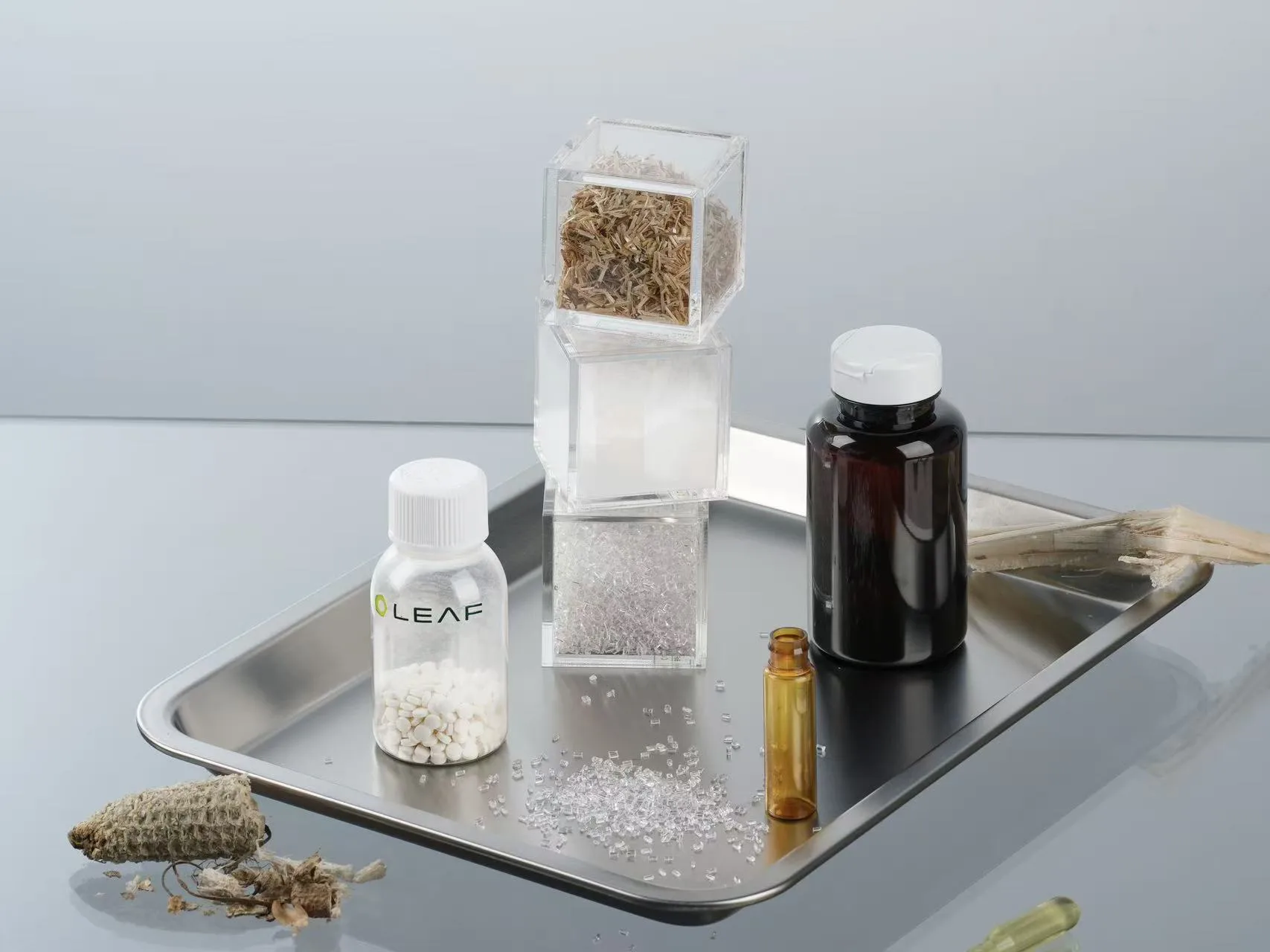
Leaf Bio’s material pathway uses agricultural waste and textile waste These resources can be processed to release natural sugars, which are then converted into FDCA through catalytic chemistry. FDCA is subsequently combined with bio-based glycol to produce PEF.
This pathway connects renewable biomass with a high-performance material at the molecular level. Instead of simply changing the source of a finished package, it introduces renewable carbon into the building blocks used to construct the material itself.
Why PEF’s Molecular Structure Matters for Barrier Performance
The furan ring restricts molecular motion within the polymer chain. Reduced chain mobility allows the molecular structure to pack more tightly, decreasing the free volume through which small gas molecules can move.
In practical terms, this makes it more difficult for oxygen and carbon dioxide to diffuse through the material.
Research has linked this mechanism directly to PEF’s reduced gas permeability. The furan ring’s rigidity suppresses molecular movement, while its polarity also influences interactions with gases such as carbon dioxide.
How PEF Preserves Flavor and Freshness
The value of a barrier material ultimately comes from what it protects.
For food and beverages, effective gas control helps maintain product characteristics throughout storage, transport, and shelf life. PEF’s combined barrier performance against both oxygen ingress and carbon dioxide loss makes it especially relevant to premium products where freshness, flavor, aroma, and carbonation are critical to quality.
The Role of the Furan Ring in Superior Gas Barrier Performance
The furan ring is a key structural feature that supports PEF’s high barrier performance.
Because the ring is rigid and constrains chain rotation, the polymer chains have less freedom to rotate and rearrange. This rigid molecular architecture leads to tight polymer packing and minimized fractional free volume, leaving far fewer and narrower tortuous pathways for gas molecules to migrate through.
As a result, oxygen and carbon dioxide diffuse more slowly through PEF. By systematically restricting this molecular exchange, the furan-based structure provides the foundation for protecting the flavor, aroma, freshness, and carbonation of packaged products.
Limiting Oxygen Transmission to Protect Product Quality
PEF’s dense molecular structure makes oxygen diffusion more difficult, helping drastically reduce the rate of oxygen ingress into the package.
For oxygen-sensitive products such as juices, functional beverages, coffee, and other sensitive foods, limiting oxygen transmission helps slow oxidation that may affect flavor, aroma, freshness, and overall product quality. In this way, PEF’s oxygen barrier supports a packaging strategy focused on maintaining the original product experience throughout its intended shelf life.
Controlling Carbon Dioxide Loss and Maintaining Freshness
Research has reported substantially lower CO₂ permeability for PEF, with amorphous PEF showing approximately 19 times lower permeability than PET in the cited study.
This lower CO₂ transmission helps reduce carbonation loss from the package, making PEF relevant to carbonated drinks such as soda and sparkling water. By keeping more CO₂ within the package, PEF can help preserve the carbonation, mouthfeel, and fresh sensory experience expected by consumers.
Supporting Aroma and Flavor Retention for Extended Shelf Life
For premium products, freshness is not defined by a single property.
Products like coffee and specialty teas derive their primary value from delicate, volatile aroma compounds and subtle flavor notes. Packaging must therefore prevent these light volatile molecules from permeating out while blocking oxygen from entering.
PEF’s high intrinsic barrier performance fulfills this dual protection requirement, safeguarding complex aromatic profiles and extending effective shelf life across global distribution channels.
Real-World Applications: From High-Barrier Bottles to Food Packaging Solutions
PEF resin has been evaluated and demonstrated across bottles, films, and other packaging formats, particularly for applications where product protection and shelf life are important.
High Barrier PEF Bottles for Carbonated and Oxygen-Sensitive Beverages
Beverage packaging is one of the clearest applications for PEF. It can be used for soda, sparkling water, ready-to-drink (RTD) coffee and tea, flavored beverages, dairy products, yogurt drinks, and beer. Leaf Bio lists these categories among the typical applications for ECOPEF® bottle-grade resin.
Furthermore, ECOPEF® can withstand processing temperatures up to 85°C, effectively supporting demanding filling lines involving hot-fill processes and pasteurization without compromising structural container integrity.
Food Packaging for Fresh and Sensitive Products
Beyond beverage containers, PEF resin can be converted into high-barrier films and rigid containers for food packaging. Typical application areas include fresh produce, bakery products, snack foods, and specialty foods that require precise control over oxygen ingress and moisture movement.
Aroma-Sensitive Packaging for Coffee and Tea
Coffee and tea require packaging solutions specifically tailored to preserve intense aroma profiles and delicate taste notes. PEF resin can be integrated into high-barrier packaging formats—such as single-serve capsules, flexible barrier pouches, and rigid containers—designed to block atmospheric oxygen while sealing in aromatic volatile compounds.
PEF for the Next Generation of Premium Sustainable Packaging
The future of packaging requires more than renewable sourcing. Materials must also deliver the functional performance required for real-world product protection, extended shelf life, efficient processing, and commercial durability.
PEF resin brings these requirements together by combining renewable feedstocks with a furan-based structure that provides strong oxygen and carbon dioxide barrier performance. For sustainable packaging materials, this combination protects product quality while supporting the shift toward renewable resources.
The opportunity extends beyond developing another packaging material option. PEF resin shows how molecular design can connect renewable resources with functional performance, opening new possibilities for high-performance sustainable packaging materials.
Research Source
Research and scientific information referenced in this article are based on the following review:
Sousa, A. F., et al. (2021). Recommendations for replacing PET on packaging, fiber, and film materials with biobased counterparts. Green Chemistry, 23, 8795–8820. DOI: 10.1039/D1GC02082J.
The review provides research-based insights into bio-based materials, including PEF, FDCA, renewable feedstocks, and their potential applications in packaging, fibers, and films.