



Sustainability has become a defining priority for the packaging industry. While voluntary commitments and corporate ESG strategies have driven progress over the past decade, regulation is now becoming an equally powerful force shaping the future of packaging innovation.
Entering into application on 12 August 2026, the European Union’s Packaging and Packaging Waste Regulation (PPWR) establishes a harmonized framework governing packaging throughout its full life cycle—from material selection and product design to manufacturing, distribution, collection, recycling and end-of-life management.
For packaging manufacturers, material suppliers, converters and consumer brands, understanding PPWR is no longer simply about meeting regulatory obligations. Future competitiveness will increasingly depend on the ability to integrate material innovation, circular design and life-cycle thinking from the earliest stages of product development—transforming regulatory change into a catalyst for long-term value creation.
What Is PPWR?
The Packaging and Packaging Waste Regulation (PPWR), officially Regulation (EU) 2025/40, establishes a new legislative framework for packaging across the European Union. Replacing the previous Packaging and Packaging Waste Directive, PPWR introduces directly applicable rules that create a harmonized approach to packaging sustainability, circularity and waste management across all EU Member States.
At its core, PPWR is designed to accelerate Europe’s transition toward a more circular packaging system. The regulation pursues three overarching objectives:
- Prevent unnecessary packaging while promoting reuse, refill and high-quality recycling;
- Harmonize packaging requirements across the European Union to reduce trade barriers and ensure a level playing field for businesses;
- Support the EU’s circular economy and climate neutrality ambitions, contributing to the European Green Deal’s goal of achieving climate neutrality by 2050.
Rather than focusing primarily on packaging waste after products have been used, PPWR represents a significant shift toward designing packaging with circularity in mind from the very beginning. The PPWR represents a significant step forward in Europe’s commitment to a circular economy and environmental stewardship.
To translate these ambitions into practical requirements, the regulation is built around several core principles that collectively reshape how packaging is designed, produced and managed throughout its life cycle:
- Designing packaging for circularity, ensuring packaging is recyclable by design and capable of being effectively collected, sorted and recycled at scale.
- Preventing unnecessary packaging, by minimizing packaging weight, volume and empty space while maintaining product functionality and safety.
- Promoting reuse and refill systems, encouraging packaging designed for multiple use cycles and supporting reusable packaging infrastructure across key sectors.
- Improving resource efficiency, through greater use of recycled content where required, enhanced material recovery and higher recycling performance.
- Strengthening transparency and producer responsibility, requiring greater traceability, technical documentation and extended producer responsibility (EPR) throughout the packaging value chain.
- Harmonizing packaging requirements across the European Union, creating a consistent regulatory framework that facilitates the free movement of compliant packaging within the EU Single Market.
Together, these principles reflect a fundamental evolution in packaging policy—from managing waste at the end of a product’s life to designing packaging systems that prioritize resource efficiency, recyclability and circularity from the outset.
Why PPWR Represents a Turning Point for the Packaging Industry
The most important implication of PPWR is that it shifts sustainability considerations to the beginning of product development rather than the end.
Historically, packaging design was largely driven by product protection, manufacturing efficiency, logistics and cost. Environmental considerations were often addressed later through recycling initiatives or waste management programs.
PPWR reverses this approach.
Packaging is increasingly expected to be designed with its entire life cycle in mind. Decisions made during material selection, structural design and manufacturing now directly influence future compliance, recyclability and environmental performance.
This represents a broader evolution from designing packaging solely for functionality toward designing packaging for circularity.
As a result, packaging development is becoming a multidisciplinary process where performance, resource efficiency, recyclability and regulatory readiness must all be considered simultaneously.
Five Strategic Implications of PPWR for the Packaging Industry
1. Packaging Must Be Designed for Recycling
Under PPWR, recyclability is no longer simply a desirable characteristic—it becomes a fundamental design requirement.
Packaging should be designed so that materials can be effectively collected, sorted and recycled at scale. Future recyclability performance grading will further encourage packaging solutions that support efficient recycling systems.
This places greater emphasis on material compatibility, simplified structures and design choices that facilitate circular material flows.
2. Packaging Reduction Becomes a Design Priority
The regulation introduces stricter measures to prevent unnecessary packaging.
Companies are expected to minimize packaging weight and volume while maintaining product functionality and protection. Packaging that artificially increases perceived product volume, such as false bottoms or unnecessary double walls, will face increasing scrutiny.
For brands, optimizing packaging design is becoming both a sustainability objective and a regulatory expectation.
3. Reuse and Refill Systems Continue to Expand
Beyond recycling, PPWR encourages the wider adoption of reusable packaging systems across multiple sectors.
The regulation establishes reuse targets for transport packaging, grouped packaging and beverage packaging, while also supporting refill models in retail environments.
Although implementation will vary across industries, the overall direction is clear: future packaging systems are expected to extend product life cycles rather than relying solely on single-use formats.
4. Greater Transparency Across the Value Chain
PPWR also strengthens documentation and traceability requirements throughout the packaging supply chain.
Manufacturers, importers and suppliers are expected to maintain technical documentation, conformity assessments and supporting information demonstrating compliance.
This reflects a broader industry trend toward greater transparency in materials, sourcing and environmental performance.
5. Material Selection Becomes More Strategic
As PPWR raises expectations for recyclability, resource efficiency and circularity, the choice of packaging materials increasingly influences both product performance and long-term regulatory readiness.
Rather than evaluating materials solely on cost or performance, companies are increasingly assessing them according to broader criteria, including recyclability, carbon footprint, renewable feedstocks potential and long-term regulatory compatibility.
Material innovation is therefore becoming one of the most important enablers of future-ready packaging.
What Future Packaging Materials Need to Deliver
As packaging requirements evolve, the next generation of materials must address multiple dimensions simultaneously.
Sustainable packaging cannot rely on a single performance indicator. Instead, future materials will need to balance several interconnected priorities.
Circularity-Driven Design
Future packaging materials should support circular systems by enabling efficient recovery, recycling or other responsible end-of-life pathways. The ability of materials to integrate into existing and emerging circular infrastructure will become increasingly important.
Renewable Resource Foundations
As industries transition away from conventional fossil-based feedstocks, renewable material sources are gaining attention. Bio-based materials derived from renewable biomass offer new possibilities for developing packaging solutions with reduced dependence on finite fossil resources.
However, renewable origin alone is not enough. Future materials must combine sustainable sourcing with strong technical performance.
High Performance for Real Applications
Packaging materials must continue to meet demanding functional requirements, including:
- Barrier properties;
- Mechanical strength;
- Processing compatibility;
- Product protection.
Sustainability and performance are no longer separate goals—they must advance together.
Lifecycle Thinking
The future of packaging requires a broader perspective that considers the entire material journey:
Raw material sourcing → Manufacturing → Application → Collection → Recycling
Lifecycle thinking enables companies to evaluate materials based on their overall contribution to more resource-efficient packaging systems.
From PPWR Requirements to Material Innovation: Leaf Bio’s Approach
At Leaf Bio, we believe that the future of packaging begins with better molecular innovation.
Our plant-based material innovation platform focuses on developing the next-generation materials derived from renewable biomass – agricultural waste and textile waste, supporting the transition toward packaging solutions that combine improved sustainability with high performance.
Through our ECOPEF®, we continue to advance plant-based material technologies designed for demanding packaging applications. Beyond being 100% plant-based origin, ECOPEF® redefines circularity through flexible end-of-life pathways. It is fully compatible with diverse recycling processes for a true closed-loop lifecycle. By leveraging renewable resources and advanced polymer innovation, our goal is to contribute to packaging systems that support circular design principles while maintaining the performance requirements expected by modern brands and converters.
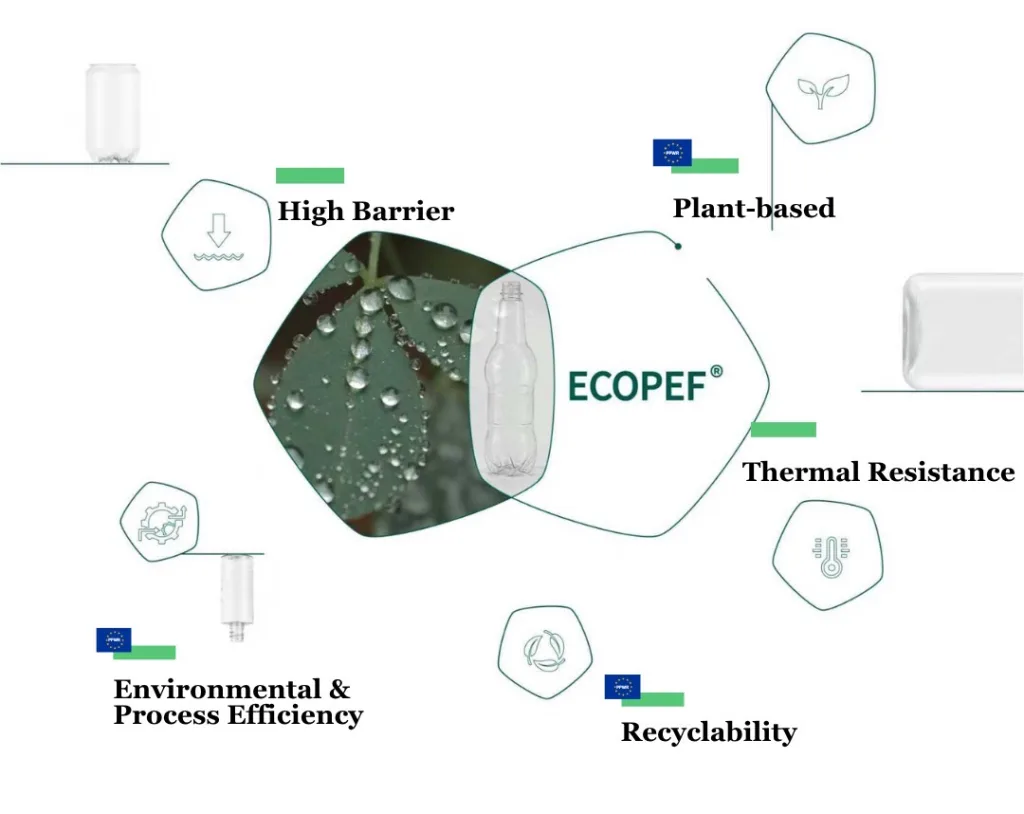
As the regulatory landscape moves toward a more circular and resource-efficient packaging future, PPWR continue to reshape the packaging landscape, collaboration across the value chain—from raw material innovation to packaging design and recycling infrastructure—will be essential for accelerating meaningful progress.
The Future of Sustainable Packaging Innovation
PPWR marks an important milestone in Europe’s transition toward a circular economy, but its broader significance extends beyond regulation itself.
It reflects a changing understanding of what packaging should achieve—not only protecting products but also supporting resource efficiency, climate objectives and long-term circularity.
For the packaging industry, this represents an opportunity to rethink materials, redesign systems and develop solutions that create value throughout the entire product life cycle.
As sustainability expectations continue to evolve, material innovation will play an increasingly important role in enabling packaging that delivers both environmental responsibility and technical performance.The future of packaging will not be defined solely by compliance. It will be defined by innovation.